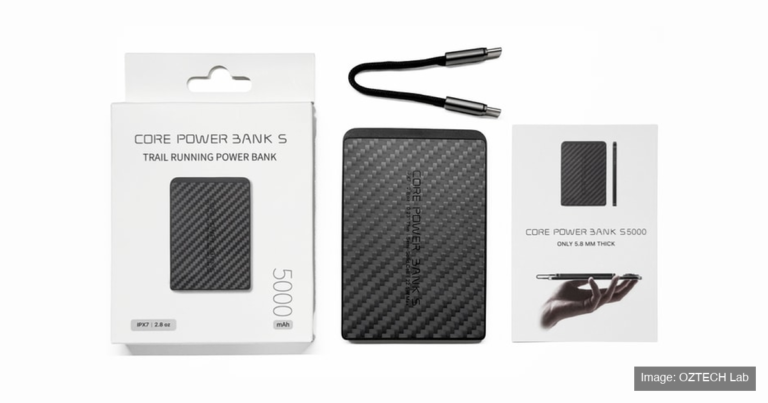
A 5,000 mAh power bank smaller than a credit card, from a company that has run nine Kickstarter campaigns and funded every one of them, several by more than twenty times over. On the crowdfunding record alone that is a strong track record. What buyers say after delivery reads very differently, and both halves are on this page.
Maker: Futurizta Tech Pty. Ltd., Sydney, Australia (ABN 49653892838)
Price: US$24.90 for the Pixy Mini, marked down from a US$39.99 regular price on the maker’s own store. Confirmed on 7 August 2026 and may change.
Nine campaigns, all funded
The creator account shows nine created projects, one backed project, and was opened in April 2019. It last logged in on 5 August 2026 — two days before we looked.
| Campaign | Ended | Funded to |
|---|---|---|
| Pixy Mini | Nov 2021 | See table below |
| Zeus-X Go Ultra — 6-in-1 240W keychain cable | Jul 2023 | 6,657% |
| Pixy Mini Pro — 30W 10k powerbank | Feb 2025 | 869% |
| Pixy Tag — Apple Watch powerbank with Find My | Oct 2025 | 696% |
| Atlas — 5-in-1 MagSafe wallet | Late pledges active | 3,112% |
| Hydra — triple Type-C 100W LED cable | Late pledges active | 1,617% |
| Pixy Go 2 | Late pledges active | 890% |
Not one of these campaigns carries Kickstarter’s “Marked as fulfilled” label. The label is set by the creator, so its absence is a choice not to use a feature rather than evidence of failure. But across nine campaigns and five years, it is a consistent absence.
The Pixy Mini campaign
| What | Figure |
|---|---|
| Funding period | 5 October – 9 November 2021 (35 days) |
| Raised | AU$206,946 |
| Backers | 2,646 |
| Updates posted | 22 |
| Comments | 1,246 |
| Delivery the maker promised | December 2021 |
| Last update | 3 March 2026 |
An update posted in 2026 on a campaign that closed in 2021 is a good sign, and 1,246 comments means the discussion was substantial. The product is on open retail sale today, so the campaign delivered.
One number in the company’s own description does not add up
The creator profile states the company has raised “over $1 million raised across 6 successful campaigns”. The same page lists nine created projects.
The likely explanation is dull: the bio was written when there were six and never updated. We mention it because it is the kind of detail that is easy to check and easy to leave stale, and because the rest of that sentence (Amazon Launchpad, Red Dot Design, 100,000+ users) is made of claims we could not confirm anywhere independent.
What buyers say afterwards
On Trustpilot, Futurizta Tech Pty. Ltd. holds a TrustScore of 1.8 out of 5 — rated “Poor” — from 32 reviews. The company claimed its profile in October 2018. We read the page directly on 15 August 2026; eight days earlier it stood at 1.9 from 31 reviews, so the sample is still moving.
Two things must be said alongside that number, and Trustpilot says both of them itself on the same page:
- “No recent history of asking for reviews” — Trustpilot notes the company has not invited customers recently, so the reviews may not be representative. Companies that actively solicit reviews collect a broad sample; companies that do not tend to collect the people motivated enough to arrive unprompted, who skew unhappy. 31 reviews is a small, self-selected sample and should not be read as a survey.
- “Hasn’t replied to negative reviews”, which is itself the complaint most of the negative reviews make.
The recent reviews are not uniform. One from July 2026 calls the products decent and the customer service the worst the writer has encountered — that pairing, good hardware and unanswered emails, recurs. One from June 2026 describes a domestic delivery within Malaysia taking about a week with no reply from the company’s official channel. One from four days before we looked describes material quality declining relative to a Zeus-X bought in 2023, which that reviewer still rates highly. A verified review from February 2024 is straightforwardly positive about both the cable and the delivery speed.
Read together, the pattern is about the company rather than the product: the hardware gets praised roughly as often as the support gets criticised. That is a real thing to know before ordering, and it is not the same as “the product is bad”.
What the maker publishes about the Pixy Mini
| What | Figure |
|---|---|
| Capacity | 5,000 mAh at 3.7 V |
| Cell | A-grade lithium-ion 21700 |
| Output | 20 W PD over USB-C, 18 W QC 3.0 over USB-A |
| Input | 18 W PD over USB-C |
| Weight | 98 g (3.45 oz) |
| Dimensions | 7.5 × 3.5 × 2 cm (2.95 × 1.38 × 0.79 in) |
| Indicators | 4 LEDs for remaining charge |
| Modes | Fast, low-current, pass-through |
| Warranty | 1 year, international |
| Watt-hours | Not published (see below) |
| Recharge time | Not published |
| Certifications | Not published |
| Cycle life | Not published |
The specification sheet is more complete than most: the cell format, both output standards and the input rating are all named, which many makers omit.
One claim we can check with arithmetic. The maker calls the Pixy Mini “airline-safe for carry-on travel” and does not publish a watt-hour figure. From its own numbers, 5,000 mAh at 3.7 V is 18.5 Wh. Airlines generally allow lithium batteries up to 100 Wh in carry-on without approval. At 18.5 Wh this sits comfortably inside that limit, and the claim holds. We would still rather the figure were printed on the page, because it is the number cabin crew ask about.
Pros
- Nine funded campaigns and a creator account active in early August 2026
- 20 W USB-C PD and 18 W QC 3.0 out, 18 W in, on a named 21700 cell
- 98 g and smaller than a credit card in footprint, with the dimensions published
- 18.5 Wh by the maker’s own figures, so the carry-on claim checks out
- A stated 1-year international warranty at US$24.90
- The campaign page was still being updated in 2026, five years after it closed
Cons
- A Trustpilot score of 1.8 out of 5, with unanswered support the recurring complaint
- Trustpilot notes the company has not replied to negative reviews
- None of the nine campaigns is marked fulfilled
- The company’s own profile says six campaigns where the platform lists nine
- Awards and user numbers claimed in the profile that we could not confirm anywhere
- No watt-hour figure printed, despite an explicit air-travel claim
- No published measurement of the battery by anyone outside the company
- The Trustpilot reviews span 2024 to within days of our reading, so we cannot say whether the support problems are current or historical
Where this leaves a buyer
Buy it for the size. At US$24.90 for a 5,000 mAh bank that fits a card slot, the hardware is the point and the price is low enough that being wrong is cheap. Buy it somewhere with a returns desk you trust, because the recurring complaint here is not the product, it is what happens when you need help.
FAQ
Should the Trustpilot score put me off?
It should inform you, not decide for you. 1.8 from 32 self-selected reviews is a warning about buying direct and needing help afterwards; it is not a measurement of the hardware, which reviewers on the same page often praise. If you are the kind of buyer who will need support, weigh it heavily. If you want a cheap small battery and would shrug at a slow reply, weigh it less.
Can I take it on a plane?
By the maker’s own figures it is 18.5 Wh, well under the 100 Wh threshold airlines generally apply to carry-on lithium batteries. Check your airline’s rules, which vary.
Did the Kickstarter backers receive it?
The evidence points that way — 22 updates, 1,246 comments, and the product in open retail since.
How fast does it charge?
20 W out over USB-C and 18 W in, per the maker. No recharge time is published and nobody outside the company has measured it.
Is US$24.90 the real price?
It is the price on the maker’s store on 7 August 2026, marked down from US$39.99. Check before you buy.
Where to buy
Futurizta Pixy Mini 5000mAh Power Bank
US$24.90 (regular US$39.99)
1-year international warranty stated. Buyers on Trustpilot report slow or absent replies from support — factor that in if you may need help after ordering.
Loupe has not handled this product. Every figure above is linked to the source it came from.